
Running a business today demands speed, clarity, and financial discipline. Yet many founders, freelancers, and digital nomads still struggle to maintain accurate books while operations, clients, and growth are all being juggled at once. Remote bookkeeping has emerged as a practical, reliable answer, a way for professional accounting support to be accessed without the overhead cost of hiring in-house staff.
In this guide, everything that needs to be known about remote bookkeeping is brought together: how it actually works, what it costs, which tools are needed, and why it is relied on by companies ranging from early-stage startups to established global businesses.
What Is Remote Bookkeeping?
Remote bookkeeping is the practice of financial records being managed from anywhere using cloud accounting tools, rather than a bookkeeper being physically present in an office to handle the same tasks. Instead of transactions being handed over on paper or reviewed in person, records are accessed, categorized, and reconciled entirely online, with financial statements being prepared and shared digitally.
This shift is made possible largely because digital payments, cloud banking, and online invoicing have become the default for most modern businesses, removing much of the friction that once made remote financial management impractical. Because everything runs through cloud platforms, the same level of accuracy and structure can be maintained regardless of where the bookkeeper or the business owner happens to be located
This arrangement has become the default choice for many lean, modern businesses that want accuracy without the overhead a traditional in-house setup requires.
Also Read: PT PMA Tax Obligations in Indonesia: Guide to Income Tax, VAT, and Withholding
Who Actually Uses Remote Bookkeeping
Remote bookkeeping is used by a genuinely wide range of businesses, from early-stage startups with minimal transaction volume to established companies managing operations across multiple countries. Digital nomads and freelancers are particularly well served by this model, since their work location changes frequently while their financial reporting needs remain constant regardless of where they happen to be.
E-commerce businesses also rely heavily on remote bookkeeping, given how much visibility is needed into inventory costs, advertising spend, and margins across potentially high transaction volumes.
Agencies and consulting firms use remote bookkeeping to keep client-related invoicing and project costs organized without dedicating internal staff purely to that function. Across all of these use cases, the common thread is a need for accurate, consistent financial data without the fixed cost of a full-time, physically present bookkeeper.
How Remote Bookkeeping Works Step by Step
Secure Access and Transaction Categorization
The process typically begins with view-only access being granted to a bookkeeper for accounting tools or bank feeds, meaning permissions exist only to read and classify transactions, not to move money. From there, expenses and income are categorized on a daily or weekly basis, and this categorization step is treated as the foundation everything else in the process depends on.
Every transaction needs to land in the correct category for financial reports to be trusted later, which is why this stage is rarely rushed by an experienced remote bookkeeper. Bank feeds are reviewed consistently rather than in occasional batches, since a steady rhythm here is what prevents a backlog from quietly building up.
This foundational work, though relatively unglamorous, is exactly what determines how reliable every later report will actually be.
Reconciliation, Reporting, and Monthly Advisory
Every transaction is matched against a corresponding bank record during reconciliation, a step designed specifically to ensure nothing has been missed or accidentally duplicated. Monthly reports are then prepared, typically including a profit and loss statement, a balance sheet, and a cash flow summary, giving a business owner a clear, structured view of financial performance for that period.
A good remote bookkeeper does not simply input data; insight is offered alongside the numbers, helping a business understand what the figures actually mean rather than leaving that interpretation entirely to the client. This advisory layer is what genuinely separates a strong remote bookkeeping relationship from one that simply produces reports without context. Clarity, not just data, should be walked away with at the end of every month.

Why Businesses Are Choosing Remote Bookkeeping
Lower Cost Without Sacrificing Expertise
Hiring in-house can be expensive once salary, training, benefits, and office overhead are all factored in, whereas remote bookkeepers offer professional service at a fraction of that total cost. This cost advantage does not typically come at the expense of expertise, since many remote bookkeeping providers specialize specifically in this delivery model and invest accordingly in training and platform proficiency. Because a remote arrangement avoids the fixed costs tied to a physical hire, businesses are able to scale the level of support they receive up or down as their needs change, something a full-time in-house hire makes considerably harder.
This flexibility is particularly valuable for early-stage businesses whose transaction volume and complexity are still evolving month to month. Lower cost paired with genuine expertise is exactly the combination that has made remote bookkeeping so widely adopted.
Access to Global Talent and Specialized Knowledge
A business is no longer limited by local geography when hiring remote, which means a specialist who understands U.S. GAAP, Singapore tax, Australian GST, or Indonesian requirements can be engaged regardless of where the business itself is based. This access to specialized knowledge is especially valuable for businesses operating across borders, where local nuance in tax or reporting requirements can otherwise be easy to miss without the right expertise.
Digital nomads and remote teams benefit particularly from this flexibility, since financial operations can remain consistent even as the business owner’s own location changes from Bali to Lisbon to Kuala Lumpur and beyond. Whether a solo consulting business or a growing startup is being run, remote bookkeeping adapts naturally to whatever volume and complexity the business currently requires. This scalability is part of why remote bookkeeping continues to be adopted by such a broad range of business types.
Also Read: How U.S. Accountants Can Safely Outsource Bookkeeping: A Practical, IRS-Compliant Guide
How Much Does Remote Bookkeeping Cost?
Typical Pricing by Region
Pricing for remote bookkeeping varies considerably by region and complexity, though general ranges can still be useful for initial budgeting purposes. In the United States, monthly costs are commonly seen in the range of 350 to 1,200 dollars or more, depending heavily on transaction volume and reporting complexity.
Singapore-based businesses typically see costs between 250 and 800 dollars per month, while Australian businesses often fall in a similar 300 to 900 dollar range. Indonesian businesses, by comparison, tend to see considerably lower costs, generally between 80 and 300 dollars monthly, reflecting both lower labor costs and a competitive local market for these services. These figures should be treated as general benchmarks rather than fixed quotes, since actual pricing always depends on the specific scope of work involved.
What Drives Cost Up or Down
High-complexity businesses, those managing multiple revenue streams, payroll obligations, or inventory tracking, may require custom pricing well above these general ranges given the additional work involved. Transaction volume is one of the most direct drivers of cost, since a business processing thousands of transactions monthly requires considerably more bookkeeper time than one processing a few dozen.
The specific platforms and integrations being used can also affect pricing, particularly if specialized software or industry-specific reporting is required beyond standard bookkeeping. For businesses in the U.S. specifically, an IRS-compliant offshore outsourcing arrangement can be structured to remain fully compliant even while costs are kept considerably lower than a domestic hire would require.
Is Remote Bookkeeping Actually Secure?
Access Controls and Encryption Standards
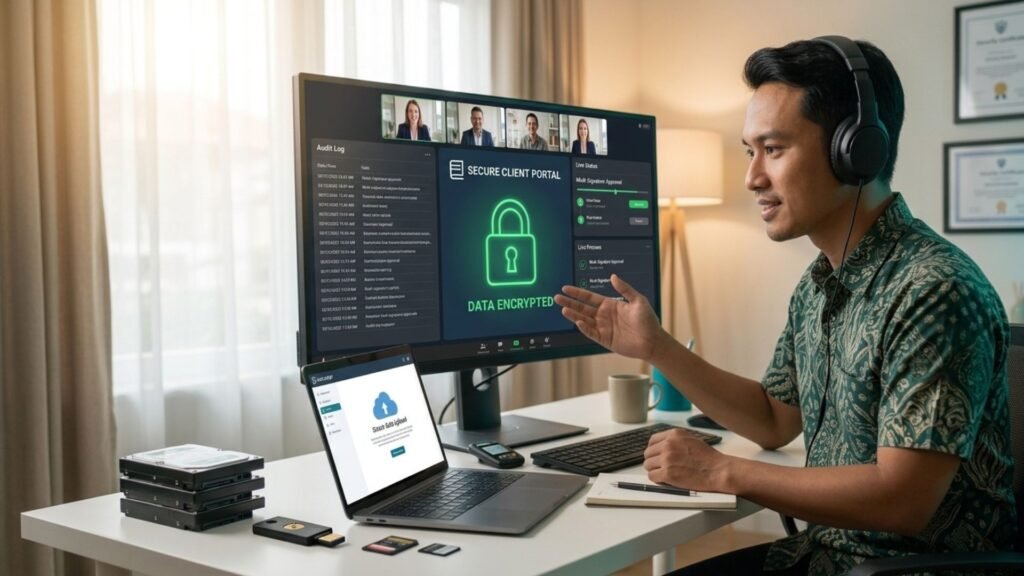
Remote bookkeeping is made extremely safe through the use of read-only access, banking-grade encryption, and carefully controlled permissions that limit what any single individual can actually do within a system. Because access is typically restricted to viewing and categorizing rather than moving funds, the risk profile of remote bookkeeping is considerably lower than many business owners initially assume.
For many small businesses, digital records maintained this way are actually safer than paper-based bookkeeping, which can be lost, damaged, or accessed without any audit trail at all. Multi-factor authentication and role-based permissions add further layers of protection, and these should be confirmed as standard practice with any remote bookkeeping provider being considered.
High-trust practices along these lines are further outlined in a dedicated guide to IRS-compliant offshore outsourcing for businesses with U.S. compliance requirements specifically.
What to Verify Before You Sign Up
Before engaging any remote bookkeeping provider, it is worth directly asking what specific access controls are used and whether multi-factor authentication is standard across their team. Data handling and confidentiality practices should be clarified in writing, ideally through a formal agreement rather than a verbal assurance alone. It is also worth confirming which cloud platforms are used and whether the provider is comfortable working within a system the business already relies on, rather than requiring a switch to an unfamiliar tool.
Asking for references or examples of similar client relationships can further confirm that security practices are being applied consistently, not just described in marketing materials. Taking these steps before signing on removes much of the uncertainty that otherwise surrounds remote financial arrangements.
Signs You’re Ready to Hire a Remote Bookkeeper
Operational Signs
If more than three hours a week are being spent dealing with receipts or categorizing expenses, this is often a clear sign that a remote bookkeeper would free up meaningful time for higher-value work. Uncertainty about whether a business is actually profitable, despite feeling busy, is another common signal that financial visibility has fallen behind operational activity. Tax deadlines that consistently arrive as a surprise, rather than being anticipated well in advance, suggest that current bookkeeping is not being kept current enough to support proper planning.
A general sense of wanting to focus on operations rather than spreadsheets is, in itself, a legitimate and common reason many business owners decide to bring in remote support. These signs, taken individually or together, tend to indicate that the time saved by outsourcing would meaningfully outweigh the cost involved.
Financial Signs
Cash flow that feels unpredictable, even when revenue appears reasonably strong, often points to a gap between what is actually happening financially and what current reporting reveals. If financial statements are consistently late or inconsistent from month to month, this is a strong signal that internal capacity has already been outpaced by the business’s actual complexity. A growing backlog of unreconciled transactions or unreviewed bank feeds is a very concrete indicator that current bookkeeping practices are not keeping pace with transaction volume.
Businesses experiencing any of these signs are far from alone, the majority of small businesses struggle in exactly the same way at some point in their growth. Recognizing these patterns early, rather than waiting for a tax deadline or investor request to force the issue, allows remote bookkeeping to be brought in proactively rather than reactively.
Conclusion
In 2026, remote bookkeeping has become the backbone of financial operations for modern businesses. Whether a startup is being scaled, multiple income streams are being managed as a digital nomad, or cash flow is simply trying to be made sense of as an SME owner, remote bookkeeping provides the accuracy and reassurance needed to make confident decisions.
If clearer numbers, fewer headaches, and more time for the work that actually matters are what’s being looked for, our team at IndoLedger works with clients across the U.S., Bali, Singapore, and Australia, offering bookkeeping that is accurate, transparent, and genuinely tailored to how modern entrepreneurs actually operate.