If someone asked you right now what your business actually owns versus what it actually owes, could you answer confidently? That single question is exactly what a balance sheet is built to answer, and it is one of the most revealing documents you can pull up about any company, including your own.
Balance sheet is a snapshot that captures your exact financial position on one specific date, down to the last Rupiah.
Investors, banks, and even your own management team lean on it constantly, because it answers a very basic but very important question is this business actually solid, or is it just looking busy?
In this article, we will walk through what a balance sheet really is, how it works, its core components, why it matters so much for your business, two real-world case study examples, and what to actually do if your numbers refuse to balance.
What Is Balance Sheet in Accounting?
A balance sheet is a financial statement that lists everything your business owns, everything it owes, and what is left over for the owners, all as of one specific date. It is one of the three core financial statements, alongside the income statement and the cash flow statement, and together they give a complete picture of a business’s financial story.
What makes the balance sheet unique is that it is not about a period of activity, like a month or a quarter, but about a single moment frozen in time, similar to a photograph rather than a video.
For business owners in Indonesia, this document is often requested by banks during loan applications, by potential investors during due diligence, and by tax authorities during audits, so keeping it accurate is not optional.
If you want a fast, honest read on where your business actually stands financially, the balance sheet is where you look first.
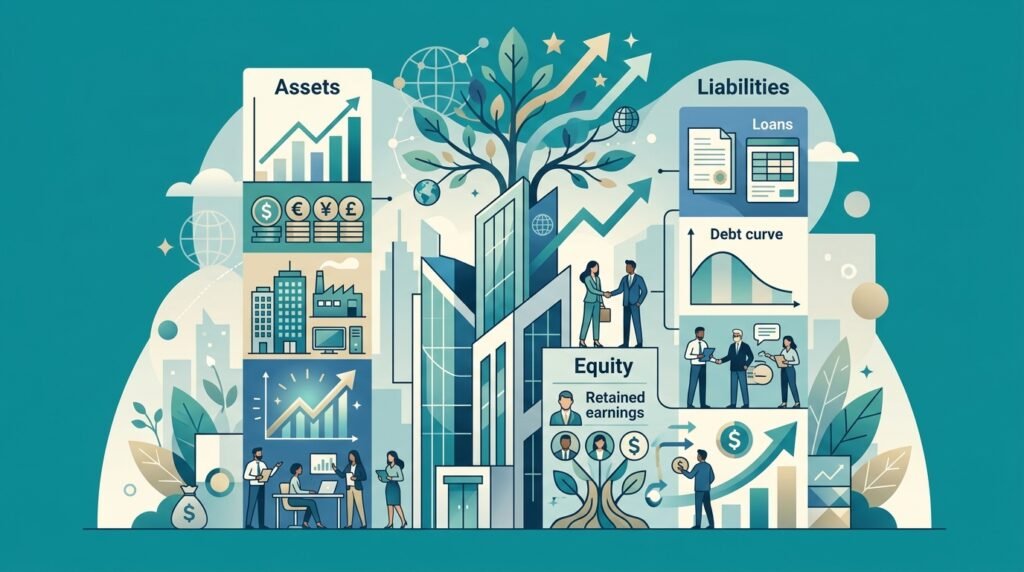
Every balance sheet is built around one unbreakable formula Assets = Liabilities + Equity. This equation is the reason the report is called a balance sheet in the first place, since both sides of this equation must always match exactly, no exceptions.
Assets represent everything of value the business controls, liabilities represent everything it owes to others, and equity represents what would be left over for the owners if every liability were paid off today.
You can also flip the formula around to say that equity equals assets minus liabilities, which is a more intuitive way to think about your own net worth in the business. Once you internalize this equation, reading any balance sheet, whether it is yours or a competitor’s, becomes far less intimidating.
Also Read: Cash Flow Statement: Components, Methods, and How to Analyze It
How Does a Balance Sheet Work?
A Snapshot at a Specific Point in Time
Because a balance sheet reflects one exact date, most businesses prepare it at the end of a reporting period, commonly monthly, quarterly, or annually. Every transaction that happens up to that cutoff date is included, and everything after it belongs to the next period’s report.
This is different from an income statement, which sums up activity across an entire period rather than freezing it at a single moment. A well-run business usually compares its current balance sheet against a previous one, say this quarter against last quarter, to see how assets, liabilities, and equity have shifted over time.
That comparison is often more useful than the single snapshot alone, since it reveals the direction the business is heading rather than just where it currently sits.
How the Two Sides Stay in Balance
Every single transaction your business records ends up affecting the balance sheet in a way that keeps both sides equal, which is the whole idea behind double-entry bookkeeping. If you take out a loan, cash goes up on the assets side while the loan balance goes up by the same amount on the liabilities side, keeping everything perfectly matched.
If you use cash to buy equipment, one asset account goes down while another asset account goes up by the same amount, so the total on the assets side never actually changes.
This self-checking mechanism is exactly why a properly maintained set of books should always produce a balance sheet that balances, assuming every transaction was recorded correctly.
You can easier to spot when something has gone wrong, since an imbalance almost always traces back to a transaction that was recorded incompletely or incorrectly.
Components of a Balance Sheet
Assets
Assets are everything of value that your business owns or controls, and they are typically split into current assets, which you expect to convert into cash within a year, and long-term or fixed assets, which take longer.
Common current assets include cash, accounts receivable, inventory, and marketable securities, while long-term assets include property, equipment, vehicles, and sometimes intangible assets like patents or trademarks. The order in which assets appear on the balance sheet usually reflects liquidity, meaning how quickly each one can realistically be turned into cash if needed.
For many Indonesian SMEs, accounts receivable and inventory tend to be the largest current asset categories, which is exactly why keeping those two balances accurate is so important for the rest of the statement to mean anything.
Understanding your asset mix also helps you judge how flexible your business actually is if it suddenly needs cash in a hurry.
Liabilities
Liabilities represent everything your business owes to outside parties, and like assets, they are split into current liabilities, due within a year, and long-term liabilities, due further out. Common current liabilities include accounts payable, short-term loans, accrued salaries, and taxes payable, while long-term liabilities typically include bank loans, leases, and bonds.
A business with a heavy concentration of current liabilities relative to its current assets can run into trouble meeting its near-term obligations, even if its long-term position looks fine on paper. Reviewing this section regularly helps you see whether your debt load is growing faster than your ability to generate cash to service it.
For lenders in particular, this section is often the very first place they look, since it tells them how much existing debt they would be competing against if they extended new credit.
Equity
Equity is what remains for the owners after every liability has theoretically been settled, and it typically includes paid-in capital contributed by the owners along with retained earnings accumulated from past profits.
For a small or family-owned business in Indonesia, this section might be fairly simple, showing owner capital and accumulated profit or loss. For a larger company, it might include common stock, preferred stock, and retained earnings broken out separately.
A growing equity balance over time is generally a healthy sign, since it usually means the business is either reinvesting profits or receiving fresh capital rather than steadily eroding its net worth. Watching this figure trend over several reporting periods is one of the simplest ways to judge whether a business is actually building long-term value or just staying afloat.
Also Read: How to Do Cash Flow Forecast? Easy Methods and Examples
Why Is Balance Sheet Important for Business?
Assessing Financial Health and Liquidity
A balance sheet gives you a fast read on whether your business could cover its short-term obligations if it needed to, simply by comparing current assets to current liabilities. This comparison, often expressed as the current ratio, tells you whether you have enough liquid resources on hand or whether you are stretched thin.
It also reveals how dependent your business has become on debt versus how much of it is actually funded by the owners’ own equity. Business owners who check this regularly tend to catch a deteriorating financial position months before it becomes an actual cash crisis.
This is one of the fastest ways to get an honest read on how financially resilient your business really is at any given moment.
Supporting Loan and Investment Decisions
Banks and investors almost always ask for a balance sheet before extending credit or committing capital, since it tells them exactly what assets exist to secure a loan and how much existing debt they would be competing against. A clean, well-organized balance sheet signals that your business keeps its books in order, which builds confidence well before anyone even gets to the numbers themselves.
It is also the document most commonly used to calculate financial ratios that lenders rely on, such as the debt ratio or financial leverage ratio, both of which directly affect how much you can borrow and on what terms. Businesses that maintain an accurate, up-to-date balance sheet consistently find the loan approval process faster and less stressful than those scrambling to reconstruct their numbers at the last minute.
In many ways, this document does more of the persuading in a funding conversation than any pitch deck or business plan ever could.
Benchmarking Performance Over Time
Comparing your balance sheet across multiple periods, whether quarter over quarter or year over year, reveals trends that a single snapshot never could on its own.
Are your liabilities growing faster than your assets? Is your equity actually increasing, or has it been quietly shrinking? These are the kinds of questions that only become visible once you line up several balance sheets side by side and watch how each category moves.
This kind of benchmarking is also incredibly useful when comparing your business against competitors or industry peers, since it shows you whether your financial structure is typical for your industry or an outlier worth investigating.
Over time, this habit of comparison turns the balance sheet from a static compliance document into a genuinely useful strategic tool.
Balance Sheet Examples in Business
A Small Retail Business
Let’s look at Toko Makmur Jaya, a small retail store selling household goods, as of December 31. The business holds Rp45 million in cash, Rp20 million in accounts receivable from a few wholesale customers, Rp80 million in inventory, and Rp55 million in store fixtures and equipment, bringing total assets to Rp200 million.
On the liabilities side, the store owes Rp30 million in accounts payable to suppliers, has Rp10 million in short-term loans, and carries a Rp60 million long-term bank loan used to renovate the storefront, bringing total liabilities to Rp100 million. That leaves Rp100 million in owner’s equity, made up of Rp70 million in original paid-in capital and Rp30 million in retained earnings accumulated over the past few years of operation.
Notice how assets (Rp200 million) exactly equal liabilities plus equity (Rp100 million plus Rp100 million), which is exactly what a correctly prepared balance sheet should always show.
Here is that same position laid out as a proper balance sheet:
| Toko Makmur Jaya – Balance Sheet as of 31 December (in IDR) | Amount |
| Assets | |
| Cash | 45,000,000 |
| Accounts Receivable | 20,000,000 |
| Inventory | 80,000,000 |
| Store Fixtures & Equipment | 55,000,000 |
| Total Assets | 200,000,000 |
| Liabilities | |
| Accounts Payable | 30,000,000 |
| Short-Term Loan | 10,000,000 |
| Long-Term Bank Loan | 60,000,000 |
| Total Liabilities | 100,000,000 |
| Equity | |
| Owner’s Capital | 70,000,000 |
| Retained Earnings | 30,000,000 |
| Total Equity | 100,000,000 |
| Total Liabilities & Equity | 200,000,000 |
As you can see, total assets of Rp200 million line up exactly with total liabilities plus equity of Rp200 million, confirming the sheet balances correctly. This layout also makes it easy to spot that a meaningful chunk of the store’s assets, the inventory in particular, is tied up in stock rather than sitting in cash.
Growing Digital Marketing Agency
Now let’s look at a different kind of business, Kreasi Digital Nusantara, a growing digital marketing agency with far fewer physical assets but a healthier cash position. As of the same date, the agency holds Rp150 million in cash, Rp90 million in accounts receivable from client retainers, and Rp30 million in office equipment and software licenses, bringing total assets to Rp270 million.
On the liabilities side, the agency owes Rp35 million in accounts payable to freelance contractors and software vendors, Rp15 million in taxes payable, and has no long-term debt at all, bringing total liabilities to just Rp50 million. That leaves a substantial Rp220 million in equity, made up of Rp100 million in owner capital and Rp120 million in retained earnings built up from several profitable years.
Comparing the two case studies side by side shows how differently a capital-intensive retail business and an asset-light service business can be structured, even when both are financially healthy in their own way.
Here is the agency’s position in the same balance sheet format:
| Kreasi Digital Nusantara – Balance Sheet as of 31 December (in IDR) | Amount |
| Assets | |
| Cash | 150,000,000 |
| Accounts Receivable (client retainers) | 90,000,000 |
| Office Equipment & Software Licenses | 30,000,000 |
| Total Assets | 270,000,000 |
| Liabilities | |
| Accounts Payable (contractors & vendors) | 35,000,000 |
| Taxes Payable | 15,000,000 |
| Long-Term Debt | – |
| Total Liabilities | 50,000,000 |
| Equity | |
| Owner’s Capital | 100,000,000 |
| Retained Earnings | 120,000,000 |
| Total Equity | 220,000,000 |
| Total Liabilities & Equity | 270,000,000 |
Here, total assets of Rp270 million match total liabilities plus equity of Rp270 million, so this balance sheet checks out too. Notice how little debt this agency carries compared to the retail store, which is fairly typical for an asset-light service business that does not need to finance physical inventory or a storefront.
What Happens If It Doesn’t Balance? What Should You Do?
What an Unbalanced Sheet Actually Means
If your total assets do not exactly equal your total liabilities plus equity, it means there is an error sitting somewhere in your books, since a balance sheet built on accurate double-entry records should never fail to balance.
This is not a matter of interpretation or rounding; even a small discrepancy signals that something was recorded incompletely, duplicated, or left out entirely.
An unbalanced sheet is a serious red flag if you are about to present it to a bank, an investor, or a tax authority, since it immediately undermines confidence in the rest of your financial reporting. It also often means other reports drawing from the same underlying data, like your income statement, may be inaccurate as well.
The good news is that an imbalance is almost always fixable once you know where to look, it just takes a bit of methodical tracing to find it.
Common Causes of an Unbalanced Sheet
The most frequent culprit is a single-sided journal entry, where only one half of a transaction was recorded instead of both, breaking the double-entry balance immediately. Another common cause is a transaction posted to the wrong account entirely, which might not break the balance itself but can distort the categories enough to make the numbers look wrong when compared to expectations.
Timing differences, such as a transaction recorded in one period but its corresponding entry recorded in another, can also create a temporary mismatch, especially around month-end or year-end cutoffs.
Manual data entry errors, like a transposed digit or a missing decimal point, are surprisingly common in businesses still relying heavily on spreadsheets rather than dedicated accounting software.
Currency conversion mistakes can also throw things off for businesses dealing in more than one currency, since even a small exchange rate error compounds across many transactions.
Steps to Fix It
Start by checking the most recent transactions first, since a recent data entry error is statistically more likely than an old one that would have already been caught in a prior review.
Next, reconcile your cash and bank balances against actual bank statements, since discrepancies here are one of the fastest ways to trace an error back to its source. If that does not resolve it, go through each major account category, assets, liabilities, and equity, one at a time, checking that every transaction has a matching, correctly recorded counterpart elsewhere in the books.
It helps to compare the current balance sheet against the last one that did balance, since isolating what changed between the two periods narrows down where the error was introduced.
If the discrepancy still will not surface after a reasonable amount of manual tracing, bringing in a professional bookkeeper or accountant is usually faster and cheaper than continuing to search alone, and it is exactly the kind of detail-heavy work that a service like IndoLedger is built to handle.
Conclusion
A balance sheet is the most honest snapshots you can get of where your business actually stands financially at any given moment. Understanding its components, knowing why it matters, and being able to recognize and fix an imbalance quickly all put you in a much stronger position, whether you are applying for a loan, courting an investor, or simply trying to run your business with a clearer head.
If keeping your balance sheet accurate and genuinely balanced every month feels like more than your team can handle on top of everything else, IndoLedger’s remote bookkeeping service can take that weight off your shoulders.
Reach out to us today to keep your financial statements clean, accurate, and tax-compliant!
If you would rather hand this over to someone who does it every day, our remote bookkeeping and accounting services are built for founders and small teams.