

If you have ever stared at your bank balance wondering whether you can cover next month’s payroll, you already understand why cash flow forecast matters. A business can be profitable on paper and still run into trouble simply because cash comes in later than the bills go out. This is exactly the gap that cash flow forecasting is meant to close.
Instead of reacting to a low balance after it happens, you get to see it coming and plan around it, whether that means chasing overdue invoices sooner or delaying a non-urgent purchase.
In this article, we will walk through what cash flow forecast really means, why it is worth your time, the components that make up a solid forecast, how often you should update it, the most common methods used by businesses in Indonesia and beyond, a simple example you can adapt, and the challenges most teams run into along the way.
What Is Cash Flow Forecast in Business?
A cash flow forecast is an estimate of how much money will move in and out of your business over a specific period, whether that is a week, a month, or a full year. It takes your current cash position and projects it forward using expected sales, planned expenses, and known payment schedules.
Unlike a profit and loss statement, it does not care about revenue you have recognized on paper; it only cares about cash that actually lands in or leaves your account. This distinction matters a lot for small and mid-sized businesses in Indonesia, where payment terms with clients or distributors can stretch out for 30, 60, or even 90 days.
A good forecast gives you an honest picture of whether you will have enough cash on hand to keep operating, not just whether you look profitable.
Also Read: Cash Flow Statement: Components, Methods, and How to Analyze It
Why Cash Flow Forecast Different from a Cash Flow Statement?
People often confuse a cash flow forecast with a cash flow statement, but the two serve very different purposes. A cash flow statement is a historical record, it tells you what already happened to your cash during a completed period, and it is usually prepared as part of your standard financial reporting.
A cash flow forecast tells you what you expect to happen based on the data and commitments you have today. Think of the statement as your rearview mirror and the forecast as your headlights.
You genuinely need both, since the statement helps you validate whether your assumptions were accurate, while the forecast helps you make decisions before problems show up. Businesses that only look backward tend to find out about a cash shortage right when it is already too late to fix it.
Benefits and Goals of Cash Flow Forecast
Keep Your Business Liquid
The most immediate goal of any cash flow forecast is making sure your business always has enough cash to cover its short-term obligations. This includes the obvious ones like payroll, rent, and supplier payments, but also less predictable costs like equipment repairs or seasonal spikes in demand.
When you can see a potential shortfall two or three weeks before it happens, you have real options such as negotiate better payment terms, follow up on overdue receivables, or arrange short-term financing before you are under pressure.
Without that visibility, most business owners only discover the problem when a payment fails to go through, which is a much more stressful and expensive place to be. Maintaining liquidity is not just about survival either; it is what allows you to take advantage of opportunities, like an early-payment discount from a supplier, when they show up.
Support Smarter Financial Decisions
A reliable forecast gives you the confidence to make bigger calls, like whether to hire another staff member, open a new outlet, or invest in new equipment. Instead of guessing whether the business can absorb a new fixed cost, you can actually model it against your projected cash position for the coming months.
This is especially useful for growing businesses in Indonesia that are scaling quickly but still operating with thin cash buffers.
It also helps you time major expenses more intelligently, for example scheduling a large inventory purchase for a month when you expect strong incoming collections rather than one where cash is already tight. Over time, this habit of forecasting before deciding tends to separate businesses that grow sustainably from those that grow themselves into a cash crisis.
Build Trust with Investors and Lenders
If you are ever applying for a business loan or pitching to investors, a well-maintained cash flow forecast signals that your business is run with discipline. Banks and investors want to see that you understand your own numbers and can anticipate problems rather than being surprised by them.
A forecast that has been tracked against actual results over time, showing that your projections are reasonably accurate, is even more convincing than a one-off spreadsheet made just for the pitch. This kind of financial transparency often makes the difference between a fast approval and a long back-and-forth full of follow-up questions.
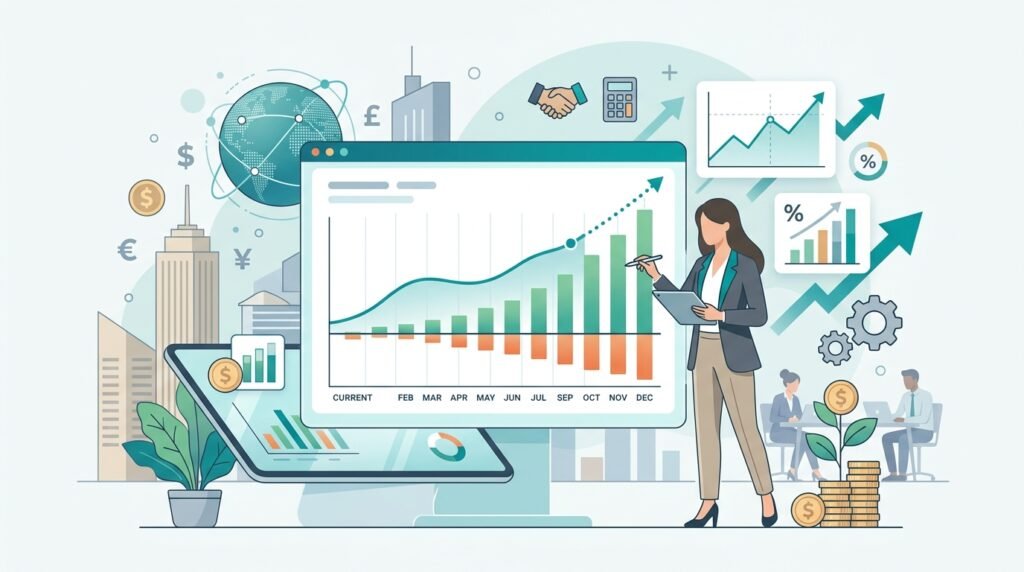
Components of a Cash Flow Forecast
Opening Balance
The opening balance is simply the amount of cash your business has on hand at the very start of the forecast period, and it is the foundation everything else is built on. If this number is wrong, every projection that follows will be wrong too, so it needs to be reconciled against your actual bank balance rather than pulled from an outdated ledger.
For businesses with multiple bank accounts or e-wallets, the opening balance should reflect the total across all of them, not just the main operating account. Getting this number right also forces you to close out the previous period properly, which is a good financial habit on its own.
Cash Inflow
Cash inflow covers every source of money coming into the business during the period, most commonly customer payments, but also things like loan disbursements, asset sales, or interest income. The accuracy of this component depends heavily on how well you understand your customers’ actual payment behavior, not just the payment terms written in the contract.
A client who is contractually due to pay in 30 days but consistently pays in 45 should be forecasted based on their real pattern, not their stated terms. This is one of the trickiest parts of forecasting for many Indonesian SMEs, since informal payment arrangements and inconsistent invoicing practices can make inflow timing hard to predict.
Cash Outflow
Cash outflow is everything leaving your business, including supplier payments, salaries, rent, taxes, loan repayments, and operational costs. Some of these are fixed and predictable, like monthly rent, while others fluctuate depending on sales volume or seasonal demand, like raw material purchases.
It helps to separate outflows into recurring obligations and one-time or irregular expenses, since lumping everything together makes it harder to spot which costs are actually flexible.
Many businesses underestimate this component because they forget less frequent but significant costs, such as annual insurance renewals or tax payments due at specific times of year.
Net Cash Flow and Closing Balance
Net cash flow is simply the difference between your total inflow and total outflow for the period, and it tells you immediately whether you are looking at a surplus or a deficit. A positive net cash flow means more money came in than went out, while a negative one signals that you are drawing down your reserves.
The closing balance is calculated by adding the net cash flow to your opening balance, and it becomes the opening balance for the next period, creating a continuous, rolling picture of your cash position. This closing figure is really the number that matters most to decision-makers, since it answers the core question of whether the business will have enough cash to operate comfortably.
Tracking net cash flow trends over several periods also helps you spot whether your cash position is steadily improving or slowly eroding, which a single month’s snapshot cannot show you.
What’s the Right Period for Cash Flow Forecast?
Short-Term Forecast
A short-term forecast typically covers anywhere from a week up to about three months, and it is built using very concrete, confirmed data like actual invoices and known payment dates. This horizon is the most accurate because there is little room for guesswork, you are mostly working with commitments that are already locked in.
Businesses that operate with tight margins or seasonal cash swings, like retail or F&B operations, benefit the most from keeping a rolling short-term forecast that gets updated weekly. It is also the horizon most useful for day-to-day decisions, such as whether you can afford to pay a supplier early or need to delay a non-critical purchase.
If you only build one type of forecast, the short-term view is usually the one that protects you from the most immediate risk.
Medium-Term Forecast
A medium-term forecast usually spans three to six months and blends confirmed data with reasonable assumptions about upcoming sales and expenses. This horizon is particularly useful for planning things like inventory buildup ahead of a busy season, a marketing campaign, or a moderate hiring plan.
Because it stretches further into the future, it naturally carries more uncertainty than a short-term forecast, so it is worth revisiting it monthly and adjusting based on how actuals compare to your earlier projections.
Many growing businesses use this horizon to decide whether they can comfortably commit to a new lease, a larger supplier order, or additional staff without straining their cash position later. It sits in a useful middle ground: detailed enough to be actionable, but broad enough to support real planning rather than just next week’s bill payments.
Long-Term Forecast
A long-term forecast covers a year or more and is mostly built on assumptions rather than confirmed transactions, since very little that far out is actually locked in. This horizon is less about precision and more about strategic direction, helping you evaluate big decisions like opening a new branch, taking on a significant loan, or entering a new market.
Accuracy naturally drops the further out you project, it is common practice to build this forecast with a base case alongside optimistic and conservative scenarios rather than a single fixed number.
Reviewing and revising the long-term forecast every quarter keeps it grounded in reality instead of becoming a static document nobody looks at again. Used well, this longer view gives ownership and management a shared sense of where the business is heading financially, even if the exact figures shift as the year unfolds.
Cash Flow Forecasting Methods
Direct Method
The direct method builds your forecast from actual, itemized cash transactions: confirmed invoices due, scheduled supplier payments, payroll dates, and known tax deadlines. Because it relies on real, near-term data rather than broad assumptions, it is generally the most accurate method available, which is why it is the standard choice for short-term forecasting.
The tradeoff is that it takes more effort to maintain, since you need clean, up-to-date records of receivables and payables rather than a single top-line revenue number. For small and mid-sized businesses, this is usually the easiest method to start with, since most of the data already exists in your invoicing and accounting records, it just needs to be organized into a forecast format.
If your business needs weekly or biweekly visibility into cash, the direct method is almost always worth the extra data-gathering effort.
Indirect Method
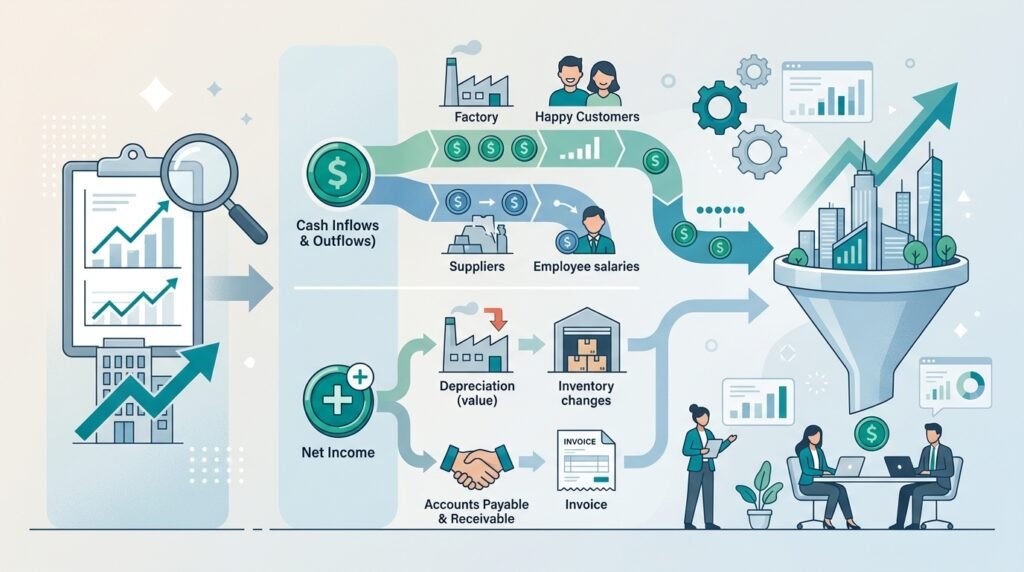
The indirect method starts from your net income and adjusts it for non-cash items like depreciation, along with changes in working capital such as receivables, payables, and inventory.
This approach connects more naturally to your income statement and balance sheet, which makes it a common choice for medium and long-term projections where you are working from financial plans rather than confirmed transactions.
It is generally faster to prepare at a high level, since you are working from summarized financial data instead of individual invoices, but it also gives you less visibility into the specific timing of cash movements.
Businesses often use this method for annual budgeting exercises or board-level financial planning, where the goal is directional accuracy rather than exact weekly figures. It pairs well with the direct method: use the indirect method for the bigger picture and the direct method for the near-term detail.
Rolling Forecast
A rolling forecast is less about a specific calculation technique and more about how often you refresh the forecast itself, updating it on a regular cadence, commonly weekly or monthly, so it always reflects your current reality. Instead of building one static forecast at the start of the year and leaving it untouched, you continuously extend the horizon forward as each period closes, replacing assumptions with actuals as they come in.
This approach is particularly valuable for businesses operating in less predictable conditions, whether that is fluctuating demand, currency exposure, or seasonal swings common in many Indonesian industries. The discipline of comparing your forecast to actual results every cycle also naturally improves your forecasting accuracy over time, since you can see exactly where your assumptions were off.
Many finance teams combine a rolling short-term direct forecast with a rolling medium-term indirect forecast to get both near-term precision and longer-range planning in one continuous process.
Cash Flow Forecast Example
Monthly Forecast for a Small Distribution Business
Let’s walk through a simplified example for a small distribution business to make these concepts concrete.
In January, the business starts with an opening balance of Rp50 million, expects Rp120 million in cash inflow from customer collections, and projects Rp95 million in outflow covering supplier payments, salaries, and rent. That gives a net cash flow of positive Rp25 million for the month, bringing the closing balance to Rp75 million, which then becomes February’s opening balance.
In February, the business anticipates a slower collection month with only Rp90 million in inflow, while outflow rises to Rp100 million due to a scheduled equipment repair, resulting in a negative net cash flow of Rp10 million and a closing balance of Rp65 million.
Seeing this dip ahead of time, in the actual forecast rather than after the fact, gives the owner a chance to follow up on a large overdue invoice or delay a non-urgent purchase before the shortfall actually happens, which is really the entire point of building the forecast in the first place.
Here is the same forecast laid out in table form, which is how you would actually present it for monthly planning:
| Monthly Cash Flow Forecast – Distribution Business (in IDR) | January | February |
| Opening Balance | 50,000,000 | 75,000,000 |
| Cash Inflow (customer collections) | 120,000,000 | 90,000,000 |
| Total Cash Inflow | 120,000,000 | 90,000,000 |
| Cash Outflow – supplier payments, salaries, rent | 95,000,000 | 88,000,000 |
| Cash Outflow – equipment repair | – | 12,000,000 |
| Total Cash Outflow | 95,000,000 | 100,000,000 |
| Net Cash Flow | 25,000,000 | (10,000,000) |
| Closing Balance | 75,000,000 | 65,000,000 |
Notice how the closing balance from January simply rolls forward to become February’s opening balance, which is exactly how a rolling monthly forecast should work in practice. The dip in February is visible weeks in advance in this format, giving the owner time to react instead of being surprised by it.
Weekly Forecast for a Small F&B Business
A restaurant or cafe deals with much faster-moving cash than a distribution business, which is why a weekly forecast, rather than a monthly one, tends to be more useful for this kind of operation. Let’s look at a small F&B business over a four-week period to see how this plays out.
In Week 1, the business starts with Rp30 million on hand, brings in Rp45 million from dine-in and online sales, and spends Rp38 million on ingredients, staff wages, rent, utilities, and marketing, closing the week at Rp37 million.
Weeks 2 and 4 follow a similar healthy pattern, but Week 3 brings a slower sales week combined with an unplanned equipment repair, which briefly pushes net cash flow into negative territory before recovering the following week.
Laying this out on a weekly grid, rather than waiting for a monthly summary, is what lets an F&B owner spot a rough patch like Week 3 early enough to adjust staffing, delay a discretionary purchase, or negotiate a few extra days with a supplier.
| Weekly Cash Flow Forecast – F&B Business (in IDR) | Week 1 | Week 2 | Week 3 | Week 4 |
| Opening Balance | 30,000,000 | 37,000,000 | 45,000,000 | 40,000,000 |
| Cash Inflow (dine-in & online sales) | 45,000,000 | 40,000,000 | 35,000,000 | 50,000,000 |
| Total Cash Inflow | 45,000,000 | 40,000,000 | 35,000,000 | 50,000,000 |
| Ingredients & supplies | 18,000,000 | 17,000,000 | 16,000,000 | 19,000,000 |
| Staff wages | 12,000,000 | 12,000,000 | 12,000,000 | 12,000,000 |
| Rent & utilities | 6,000,000 | – | – | 6,000,000 |
| Equipment repair (unplanned) | – | – | 10,000,000 | – |
| Marketing | 2,000,000 | 3,000,000 | 2,000,000 | 2,000,000 |
| Total Cash Outflow | 38,000,000 | 32,000,000 | 40,000,000 | 39,000,000 |
| Net Cash Flow | 7,000,000 | 8,000,000 | (5,000,000) | 11,000,000 |
| Closing Balance | 37,000,000 | 45,000,000 | 40,000,000 | 51,000,000 |
The value of the weekly view really shows up in Week 3: on a monthly forecast alone, that dip would be smoothed out and easy to miss until the bank balance actually dropped. Because it is visible ahead of time here, the owner can plan around it, for example by pushing a non-essential marketing spend into Week 4 instead of keeping it fixed.
Challenges in Cash Flow Forecasting
Unpredictable Revenue and Late Payments
One of the biggest challenges any business faces is that customers do not always pay on time, and revenue itself can be seasonal or dependent on unpredictable market demand. A forecast built purely on contractual payment terms will consistently overstate how much cash you actually have available in a given period.
This is especially common in Indonesia, where informal payment culture and relationship-based business dealings can stretch agreed terms without much formal notice.
The best way to manage this is to base your forecast on historical payment behavior rather than stated terms, and to build in a reasonable buffer for the receivables you know tend to run late.
Over time, tracking which specific customers or clients consistently pay late lets you adjust their portion of the forecast individually instead of applying one blanket assumption across your whole customer base.
Manual Spreadsheets and Human Error
Many small and mid-sized businesses still build their cash flow forecast in spreadsheets, and while that is a perfectly reasonable starting point, it comes with real risks as the business grows.
A broken formula, a forgotten line item, or a version control mix-up between team members can quietly distort the entire forecast without anyone noticing for weeks. Manually pulling data from bank statements, invoices, and expense records is also time-consuming, and that time cost often means the forecast gets updated less often than it should.
The bigger the business gets, and the more accounts, entities, or currencies involved, the more this manual process starts to break down under its own weight. This is exactly the kind of repetitive, detail-heavy work that benefits from a proper bookkeeping system and a second set of trained eyes rather than a single overworked spreadsheet.
Limited Financial Expertise In-House
Building an accurate forecast requires more than just plugging numbers into a template; it requires understanding which assumptions are reasonable, how to interpret variances, and when a forecast miss reflects a real problem versus normal fluctuation.
Many growing businesses in Indonesia simply do not have a dedicated finance team, which means forecasting either does not happen at all or gets done inconsistently by whoever has time that week.
This gap tends to widen as the business scales, since more transactions, more customers, and more complexity all make forecasting harder right at the moment it becomes more important. Bringing in outside bookkeeping and financial support, even on a part-time or remote basis, is often a more practical solution than trying to hire a full in-house finance team from scratch.
This is exactly where a service like IndoLedger can help, keeping your books accurate and your cash flow forecast realistic so you can focus on running the business rather than wrestling with spreadsheets.
Conclusion
Cash flow forecast is one of the most practical tools you have for keeping your business steady and making confident decisions instead of reactive ones.
Choosing a forecasting period and method that fits your business, and staying honest about the challenges will put you well ahead of businesses that only look at their bank balance after the fact.
If building and maintaining an accurate cash flow forecast feels like more than your team can take on right now, IndoLedger’s remote bookkeeping service can help you get clean, reliable financial data flowing consistently, so your forecast is always built on numbers you can actually trust.
Reach us now to see how professional bookkeeping support can strengthen your business’s cash flow visibility!
Keeping this consistent is where most small teams fall behind. Our remote bookkeeping and accounting services cover it month by month.