

You can be looking at a profitable business on paper and still not know whether there is actually enough cash in the bank to pay next month’s bills. That gap between profit and cash is exactly why every business, no matter how small, needs a cash flow statement.
A cash flow statement tells you where your money actually came from and where it actually went during a given period, separate from accounting profit. It is one of the three core financial statements alongside the income statement and balance sheet, and honestly, for day-to-day survival, it is often the one that matters most.
In this article, we will cover what a cash flow statement really is, why it matters, its components, the methods used to build one, a step-by-step guide to preparing it, a real case study example, and how to actually read and analyze the numbers once you have them.
What Is Cash Flow Statement?
Cash flow statement is a financial report that records all the cash coming into and going out of your business during a specific accounting period, whether that is a month, a quarter, or a full year.
Unlike an income statement, which recognizes revenue and expenses when they are earned or incurred, a cash flow statement only cares about actual cash movement, meaning money that has genuinely landed in or left your bank account. This makes it one of the clearest windows into whether your business can actually pay its bills, rather than whether it looks profitable on paper.
For business owners in Indonesia, this distinction is especially important since many transactions involve credit terms, meaning revenue can be recorded weeks before the cash is actually collected.
If the income statement tells you how well the business performed, the cash flow statement tells you whether the business has the fuel to keep running.
Also Read: The Silent Damage Poor Cash Flow Planning Causes in Growing Businesses
Why Cash Flow Statement Matters More Than Profit Alone?
It is entirely possible for a business to report a healthy profit and still run out of cash, and this happens far more often than most owners expect. A company might have strong sales, but if customers are slow to pay or a large chunk of cash is tied up in unsold inventory, the bank balance can quietly shrink even as the income statement looks great.
This is exactly why lenders, investors, and even internal management teams pay close attention to the cash flow statement before making any major decision. It exposes the timing gap between when revenue is recognized and when cash is actually received, which is often the root cause of a liquidity crunch.
Purpose and Benefits of a Cash Flow Statement
Assessing Your Ability to Generate Cash
One core purpose of the cash flow statement is showing how well your core business activities generate cash on their own, without relying on loans or outside investment. A business that consistently produces positive operating cash flow is in a much stronger position than one that only stays afloat by constantly raising new financing.
This is also useful for forecasting, since a track record of solid cash generation gives you a realistic base to project future performance rather than relying purely on optimistic sales assumptions. Investors and lenders specifically look at this figure because it reveals whether the underlying business model is sustainable on its own merits.
Over several periods, watching whether this number is trending up or down tells you a lot about the true trajectory of the business, beyond what a single month’s snapshot can show.
Understanding Investment and Financing Decisions
The cash flow statement also explains why your total assets and liabilities have changed by breaking out exactly which investing or financing transactions caused the shift. If your company purchased new equipment, sold off an old asset, took on a loan, or repaid debt, all of that shows up clearly in this report rather than being buried inside a balance sheet comparison.
This transparency helps you and any external reader understand the reasoning behind changes in your financial position, not just the raw numbers themselves. For growing businesses, this is particularly useful when explaining to a bank or investor why cash dropped in a particular quarter, since a decline caused by a strategic equipment purchase tells a very different story than one caused by declining sales.
It essentially connects the dots between your balance sheet and your actual cash movements.
Confirming the Ability to Pay Obligations
A well-prepared cash flow statement lets you confirm, with real numbers, whether the business can comfortably cover payroll, supplier payments, loan installments, and dividend distributions.
This is not a theoretical exercise like missing a payroll date or defaulting on a loan installment has real, immediate consequences for staff morale and creditor relationships. Reviewing this report regularly gives you an early warning system, showing whether obligations coming due in the next period are actually covered by cash you expect to have on hand.
It also gives investors confidence that the business can meet its commitments to them, including dividend payments, without needing emergency financing. In many ways, this is the most practical, hands-on benefit of the cash flow statement for a small or mid-sized business owner.
Explaining the Gap Between Net Income and Cash
Net income and net cash are rarely the same number, and the cash flow statement is what explains exactly why they differ. Non-cash items like depreciation, changes in accounts receivable, or unsold inventory can make a business look profitable while its actual cash position tells a very different story.
Understanding this gap helps stakeholders judge whether reported profit is genuinely translating into usable cash or whether it is largely tied up in the balance sheet. This distinction becomes especially important when a business is scaling quickly, since rapid growth often ties up cash in inventory and receivables even while the income statement shows strong performance.
Recognizing this pattern early lets you plan financing or collection strategies before the mismatch becomes a real liquidity problem.
Also Read: When Doing Everything Yourself Starts Costing Your Business More
Components of a Cash Flow Statement
Operating Activities
Operating activities capture the cash generated or used by your core, everyday business operations, such as cash received from customers, payments to suppliers, salaries, and routine operating expenses.
This section usually represents the largest and most closely watched part of the statement because it reflects the health of the actual business model, separate from financing or investment decisions. A consistently positive number here suggests the business can sustain itself through its normal operations, which is exactly what most lenders and investors want to see.
If this section trends negative for several periods in a row, it is usually a signal that something in the core business, whether pricing, collections, or cost control, needs closer attention. Because it is drawn directly from day-to-day transactions, this is also the section that most closely mirrors what you would see just by watching your bank account activity.
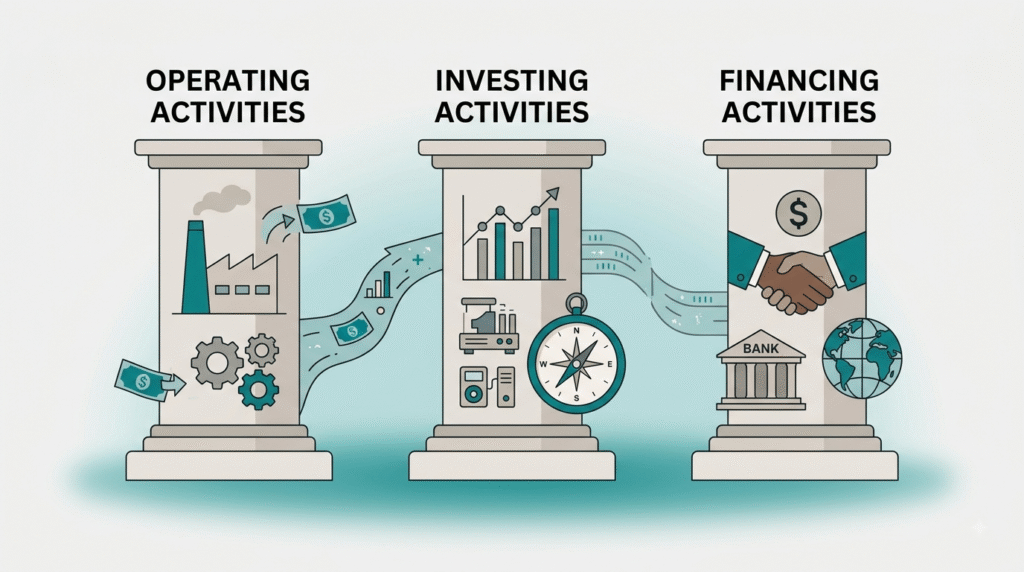
Investing Activities
Investing activities cover cash used for or generated from long-term assets, including the purchase or sale of equipment, property, vehicles, or long-term investments. A negative number here is not automatically a bad sign it is often a good one, since it can mean the business is investing in equipment or expansion to support future growth.
Conversely, a business selling off assets to generate cash may be raising money for a good reason, or it might be a warning sign that operating cash flow alone was not enough to cover obligations. Reading this section together with operating activities gives you a much clearer picture than looking at either one in isolation.
For businesses in capital-intensive industries like manufacturing or logistics, this section often carries a lot of weight in understanding the overall cash flow story for the period.
Financing Activities
Financing activities reflect cash movements involving the company’s capital structure, such as loan proceeds, debt repayments, owner capital injections, share issuances, and dividend payments. This section tells you how the business is funding itself beyond its own operations, whether through debt, equity, or owner contributions. A business that is frequently drawing on new loans just to stay afloat, without a corresponding improvement in operating cash flow, is often heading toward a more serious cash problem down the road.
A company that is steadily repaying debt while operating cash flow remains healthy is generally in a strong, sustainable position. This section is particularly important for stakeholders assessing long-term financial risk, since it reveals how dependent the business has become on external funding.
What Methods Are Used to Prepare Cash Flow Statement?
Direct Method
The direct method builds the operating activities section by listing actual cash receipts and cash payments, such as cash collected from customers and cash paid to suppliers and employees, in clearly labeled categories.
Because it works with real transaction-level data pulled from your cash book or bank records, it produces a very clear, easy-to-follow report that is straightforward for non-accountants to understand. The tradeoff is that it takes more time to prepare, since you need to reconcile cash books, bank statements, and petty cash records rather than working from summarized totals.
This method is often preferred when transparency matters most, such as when presenting to external stakeholders who want a plain, itemized view of where cash actually came from and went.
For businesses just getting serious about their bookkeeping, the direct method is also a great way to build a habit of tracking cash transactions accurately at the source.
Indirect Method
The indirect method starts from net income on the income statement and adjusts it for non-cash items like depreciation, along with changes in working capital accounts such as receivables, payables, and inventory. Because it relies on financial data that is already sitting in your existing income statement and balance sheet, it is generally faster and cheaper to prepare than the direct method
This is the method most commonly used in practice, especially for standard financial reporting purposes, since it directly connects the three core financial statements together. The downside is that it provides less granular detail about specific cash transactions, which can make it harder to trace exactly where cash movements originated.
Many businesses in Indonesia default to this method simply because the underlying data is already available from routine bookkeeping, making it the more practical choice for regular reporting cycles.
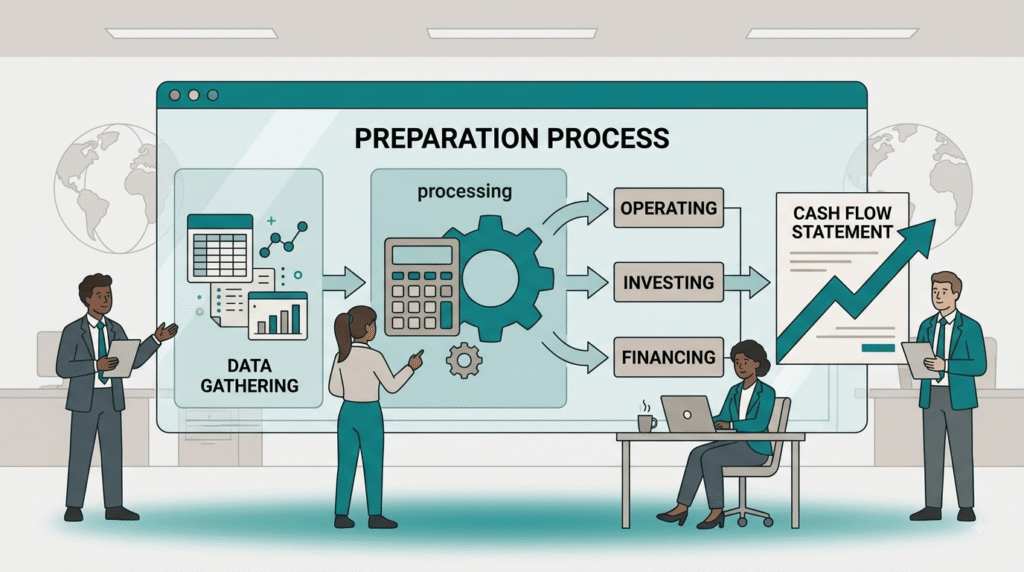
How to Prepare a Cash Flow Statement
Calculate the Change in Cash Balance
Start by comparing your cash and bank balances at the beginning and end of the period, which you can pull directly from your balance sheet or your bank and petty cash books. This gives you the total net change in cash for the period, which acts as a checkpoint you will use later to confirm your finished statement is correct.
It is worth double-checking this figure against actual bank statements rather than relying purely on your internal ledger, since small reconciliation errors here will throw off everything that follows.
Getting this number right early saves you from having to backtrack through the entire statement later looking for a discrepancy. Think of this step as setting the target you are working toward for the rest of the process.
Calculate Net Cash from Operating Activities
Next, separate out all the cash flows related to your core, day-to-day business operations and calculate the net cash generated or used in this category. If you are using the indirect method, this means starting from net income and adjusting for depreciation, changes in receivables, payables, and inventory.
If you are using the direct method, this means summing actual cash received from customers and subtracting actual cash paid to suppliers, employees, and other operating expenses. This is usually the most detailed and time-consuming section to prepare, since it involves the highest volume of individual transactions.
Take your time here, since errors in this section are the most common source of an unbalanced final statement.
Calculate Net Cash from Investing Activities
Review all transactions related to long-term assets during the period, including any equipment purchases, property sales, or investments in other companies or instruments. Cash paid out for purchases should be recorded as a negative figure, while cash received from sales should be recorded as a positive one.
This section tends to have fewer transactions than operating activities, which makes it comparatively quicker to complete once you have gathered the relevant documentation. Make sure you are only capturing long-term asset transactions here and not accidentally including routine operating purchases, which belong in the previous section.
Once totaled, this figure tells you how much cash the business allocated toward or received from its long-term investment decisions.
Calculate Net Cash from Financing Activities
Now gather all transactions related to loans, equity, and owner capital, including new borrowing, loan repayments, capital injections, share issuances, and dividend payments. Cash received from new financing, such as a loan disbursement or capital injection, is recorded as a positive figure, while repayments and dividend distributions are recorded as negative ones.
This section is usually straightforward to prepare since financing transactions tend to be less frequent and easier to trace than day-to-day operating activity. It is worth double-checking loan and dividend records against your accounting system to make sure nothing has been missed, since these transactions can sometimes be recorded in a separate module or system. Once complete, this figure rounds out the third and final major component of your statement.
Combine and Reconcile the Final Statement
Add together the net cash from operating, investing, and financing activities to get your total net change in cash for the period. Then add this total to your opening cash balance, and the result should match your actual closing cash balance from Step 1; if it does not, you know there is an error somewhere that needs to be traced back through the earlier steps.
This reconciliation step is what makes the entire statement trustworthy, since a report that does not tie back to your actual bank balance is not much use to anyone reading it. Once everything balances, format the final statement clearly with each of the three sections labeled and totaled, ready for internal review or external presentation.
This final check is quick to do but easy to skip, so make it a non-negotiable last step every time you prepare the report.
Cash Flow Statement Example: A Case Study
Case Study: PT Sinar Abadi’s Quarterly Cash Flow
Let’s walk through a simplified case study for a fictional distribution company, PT Sinar Abadi, covering the first quarter of the year. On the operating side, the company collected Rp180 million in cash from customers, paid Rp110 million to suppliers for goods, spent Rp40 million on salaries and operating expenses, and paid Rp8 million in income tax, resulting in net operating cash flow of positive Rp22 million.
On the investing side, the company sold an old delivery vehicle for Rp15 million but purchased new warehouse equipment for Rp30 million, resulting in a net investing outflow of Rp15 million for the quarter.
On the financing side, the owners injected an additional Rp20 million in capital to support the equipment purchase, while the company paid Rp6 million toward an existing bank loan, resulting in a net financing inflow of Rp14 million.
Adding these three figures together gives a net increase in cash of Rp21 million for the quarter, and if the company started the period with Rp35 million in the bank, its closing balance comes to Rp56 million, a number that should match its actual bank statement at quarter end.
Here is what that same case study looks like laid out as a proper cash flow statement, which is the format you would actually use for internal reporting or when sharing numbers with a lender or investor:
| PT Sinar Abadi – Cash Flow Statement for the Period Ended 31 March 2026 (in IDR) | Amount |
| Cash Flow from Operating Activities | |
| Cash received from customers | 180,000,000 |
| Cash paid to suppliers | (110,000,000) |
| Cash paid for salaries & operating expenses | (40,000,000) |
| Income tax paid | (8,000,000) |
| Net Cash from Operating Activities | 22,000,000 |
| Cash Flow from Investing Activities | |
| Cash received from sale of vehicle | 15,000,000 |
| Cash paid for equipment purchase | (30,000,000) |
| Net Cash from Investing Activities | (15,000,000) |
| Cash Flow from Financing Activities | |
| Owner capital injection | 20,000,000 |
| Loan repayment | (6,000,000) |
| Net Cash from Financing Activities | 14,000,000 |
| Net Increase in Cash | 21,000,000 |
| Opening Cash Balance (1 Jan 2026) | 35,000,000 |
| Closing Cash Balance (31 Mar 2026) | 56,000,000 |
Reading this table from top to bottom, you can see each of the three activities contributing a clear net figure, which then rolls up into the total change in cash for the quarter. This layout is exactly what most stakeholders expect to see, whether that is your own management team reviewing monthly performance or a bank evaluating a loan application.
Notice how the operating section alone would have been a healthy Rp22 million surplus, but the equipment investment temporarily pulled that down before the owner’s capital injection topped it back up.
This is a good example of why you should never judge a cash flow statement from a single section in isolation; the full picture only becomes clear once all three activities are read together.
Analyzing a Cash Flow Statement
Reading the Overall Cash Flow Pattern
The fastest way to analyze any cash flow statement is looking at the sign, positive or negative, of each of the three sections together rather than in isolation. A genuinely healthy, mature business typically shows positive operating cash flow, negative investing cash flow because it is reinvesting in growth, and negative financing cash flow because it is paying down debt rather than constantly borrowing more.
A business showing negative operating cash flow propped up by financing inflows is usually living on borrowed time, since it is essentially using new debt to cover the fact that the core operations are not generating enough cash on their own.
Comparing this pattern across multiple periods, rather than looking at a single quarter, reveals whether the business is on a genuinely improving trajectory or just having one good month. This kind of pattern reading takes only a few minutes but reveals far more about the business than the profit figure alone ever could.
Using Key Cash Flow Ratios
Beyond just reading the raw numbers, a few simple ratios can sharpen your analysis considerably, starting with the operating cash flow ratio, which divides operating cash flow by current liabilities to show how comfortably the business can cover its short-term obligations from operations alone.
Free cash flow, calculated as operating cash flow minus capital expenditures, tells you how much cash is genuinely left over after maintaining and growing the business, which is the cash actually available for debt repayment, dividends, or reinvestment.
The cash flow margin, calculated as operating cash flow divided by total revenue, shows what portion of every rupiah in sales is actually converting into usable cash rather than sitting in receivables or inventory.
Tracking these ratios over several periods, rather than looking at just one, is what turns a single cash flow statement into a genuinely useful diagnostic tool for the business. For business owners without a finance background, these ratios are worth learning since they translate a fairly dense financial report into a few clear, comparable numbers.
Common Warning Signs to Watch For
A few recurring patterns are worth flagging whenever you review a cash flow statement, starting with operating cash flow that is consistently lower than reported net income, which often signals that profits are stuck in receivables or inventory rather than converting into real cash.
Frequent reliance on new financing just to cover regular operating shortfalls is another red flag, since it suggests the core business is not sustainable without ongoing external support. A sudden, unexplained spike in cash from investing activities can also be worth investigating, since it may indicate the business is selling off assets to plug a cash gap rather than for genuine strategic reasons.
Persistent negative net cash flow over multiple consecutive periods, even if each individual month looks manageable, tends to compound into a serious liquidity crisis if left unaddressed.
Catching these warning signs early, ideally through consistent monthly bookkeeping and reporting rather than an occasional year-end review, is what gives a business owner enough lead time to actually fix the problem before it becomes urgent.
Conclusion
A cash flow statement is a compliance document sitting in your accountant’s files and one of the most honest tools you have for understanding whether your business can actually sustain itself day to day.
Knowing its components, choosing the right preparation method, and learning to read the patterns and ratios behind the numbers puts you in a much stronger position to make confident financial decisions rather than reactive ones.
If keeping your cash flow statement accurate and up to date every month feels like more than your team can manage alongside running the business, IndoLedger’s remote bookkeeping service can take that work off your plate. Get in touch with us today to keep your financial reporting clean, consistent, and ready whenever you need to make an important decision!
Doing this properly takes time most founders do not have. If that sounds familiar, take a look at our remote bookkeeping and accounting services.