
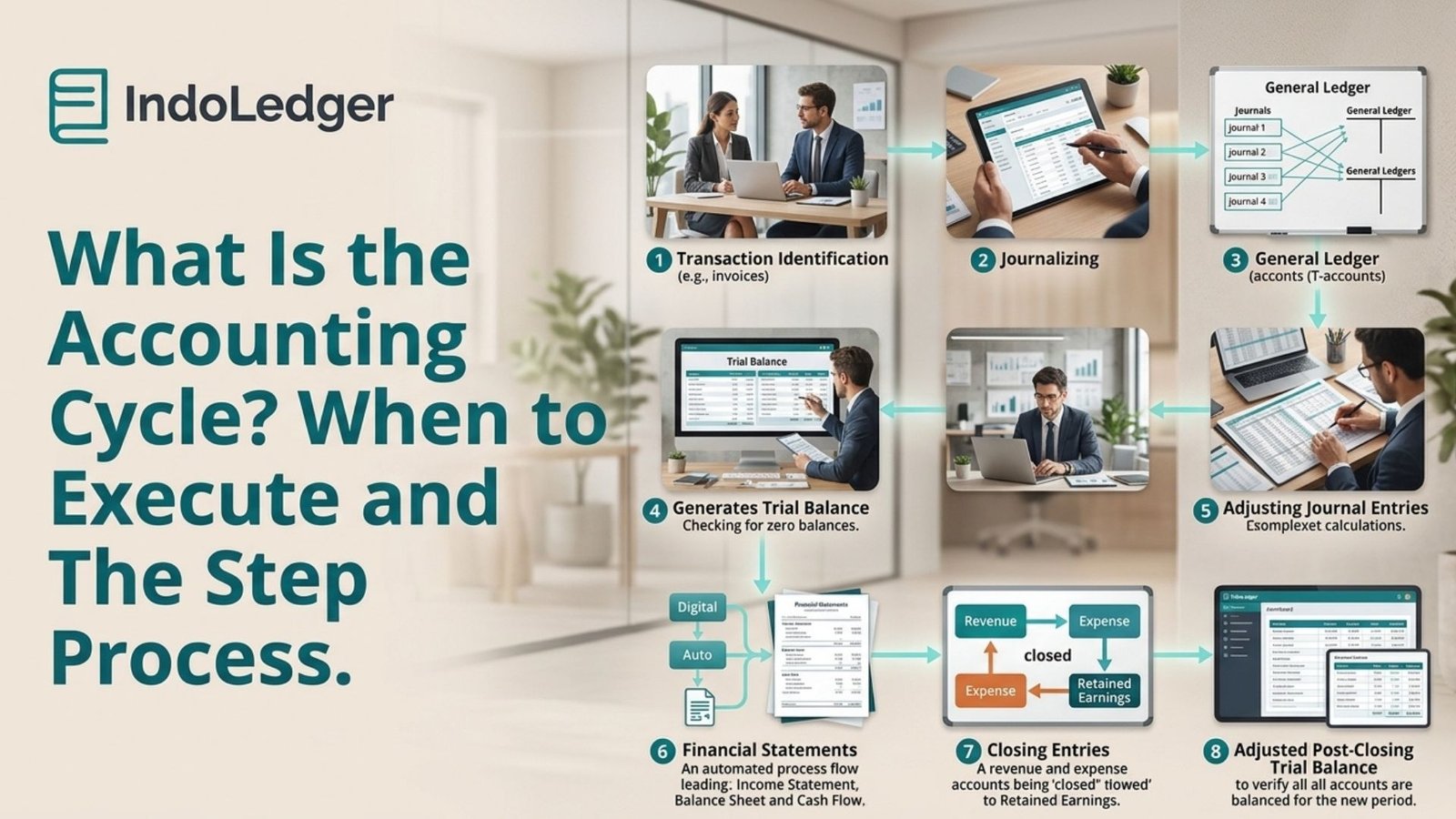
If you’ve ever looked at a set of financial statements and wondered how all those numbers actually got there, the answer is something called the accounting cycle. It’s one of the most practical concepts you can understand as a business owner.
Every sale you make, every bill you pay, and every expense you record eventually has to go somewhere, and the accounting cycle is the structured path that gets it there.
Think of it less like a scary accounting textbook chapter and more like a recipe your business follows every month or every year to turn messy transactions into a clear financial picture. Skip steps, or do them out of order, and your financial statements start looking unreliable fast.
In this article, we’ll walk through what the accounting cycle actually is, why it matters, when businesses should run through it, and exactly what each step involves, so you can either run it yourself or know what to expect when someone runs it for you.
What Is the Accounting Cycle?
The accounting cycle is the repeating, step-by-step process a business uses to identify, record, organize, and eventually report its financial transactions for a given period. It starts the moment a transaction happens, whether that’s a customer paying an invoice or your business paying rent, and it ends when the books are closed and financial statements are produced for that period.
The whole point of this cycle is consistency, the cycle forces every transaction through the same sequence of checks before it becomes part of your official financial records.
Financial statements are only useful if they’re accurate and comparable, and that reliability comes directly from following the same disciplined process every single time.
Whether your business runs this cycle monthly, quarterly, or annually, the underlying structure stays the same, which is exactly what makes it such a dependable foundation for financial management.
Also Read: What is Bookkeeping? Types, Procedures, and Example
Accounting Cycle vs. Budget Cycle: Don’t Mix Them Up
One mix-up we see often is people confusing the accounting cycle with the budget cycle, but the two actually serve very different purposes. The accounting cycle looks backward, it records and reports what has already happened financially in your business during a completed period.
The budget cycle, on the other hand, looks forward, helping you plan and allocate resources for revenue and expenses you expect in the future.
Both processes are important, they often run on similar timelines, but one tells you what actually happened while the other tells you what you’re hoping will happen.
Benefits of the Accounting Cycle
Improved Accuracy and Fewer Errors
One of the most immediate benefits of following the accounting cycle consistently is a sharp drop in errors and discrepancies in your financial records. Because each step in the cycle acts as a built-in checkpoint, mistakes tend to get caught early, at the trial balance stage, for example, rather than surfacing months later when you’re trying to file taxes or apply for a loan.
This structured approach also makes it much easier to spot patterns, like a recurring miscategorized expense or a vendor invoice that keeps getting recorded incorrectly. Over time, businesses that stick to the cycle build a track record of clean, dependable numbers, which becomes incredibly valuable the moment an investor, auditor, or bank asks to review your books.
The accuracy the accounting cycle produces makes every other financial decision you make afterward actually trustworthy.
Stronger Compliance and Audit Readiness
The accounting cycle plays a huge role in keeping your business compliant with tax regulations and reporting standards. Tax authorities expect businesses to report income and expenses consistently and on time, and the accounting cycle is exactly what produces the documentation needed to support those filings.
When your books follow a predictable, repeatable structure, responding to an audit or a tax query becomes a matter of pulling existing records rather than scrambling to reconstruct a year’s worth of transactions from memory.
This becomes especially important for businesses that operate across multiple regulatory environments, where inconsistent bookkeeping can quickly turn into a compliance headache.
Better Decision-Making and Operational Efficiency
Perhaps the most underrated benefit of the accounting cycle is how much it improves the quality of everyday business decisions. When you know your financial data is accurate and current, you can confidently decide whether to hire another employee, invest in new equipment, or cut costs in a struggling area of the business.
The cycle also creates operational efficiency, since breaking bookkeeping into clear, repeatable steps means your team, or your outsourced accounting partner, always knows exactly what needs to happen next.
This structure reduces the mental overhead of figuring out where you left off each month, which frees up time for higher-value analysis instead of repetitive administrative work.
Also Read: Cash Flow Statement: Components, Methods, and How to Analyze It

When to Execute the Accounting Cycle?
Matching the Cycle to Your Reporting Period
The accounting cycle is repeated on a schedule that matches how often your business needs financial information. Many small businesses run the cycle monthly, since this gives owners a fresh, current picture of income and expenses without waiting an entire year to find out how things are going.
Larger companies, or those with investors and lenders expecting regular reporting, often run the cycle quarterly in addition to their annual close, to keep stakeholders updated more frequently. At a minimum, every business needs to complete the full cycle at least once per fiscal year, since annual financial statements and tax filings depend on it.
Choosing the right frequency really comes down to how quickly your business needs visibility into its numbers, and how complex your operations are, since more transactions generally call for more frequent cycles.
Signs It’s Time to Tighten Up Your Cycle
Sometimes a business doesn’t need to change how often it runs the accounting cycle, but rather how well it’s running it. If you’re constantly finding discrepancies between your bank statements and your books, or if closing the books each period takes far longer than it should, that’s usually a sign your process needs tightening rather than lengthening.
Businesses that are growing quickly, adding new revenue streams, or expanding into new markets often reach a point where their old, informal approach to bookkeeping simply can’t keep up with the volume or complexity of transactions.
Similarly, if you’re regularly caught off guard by tax deadlines or investor requests for updated financials, that’s a strong signal your accounting cycle needs to run more consistently, not just more frequently.
Recognizing these signs early, rather than after a stressful audit or a missed filing deadline, is what separates businesses that stay in control of their finances from those that are constantly reacting to problems.
Steps in the Accounting Cycle
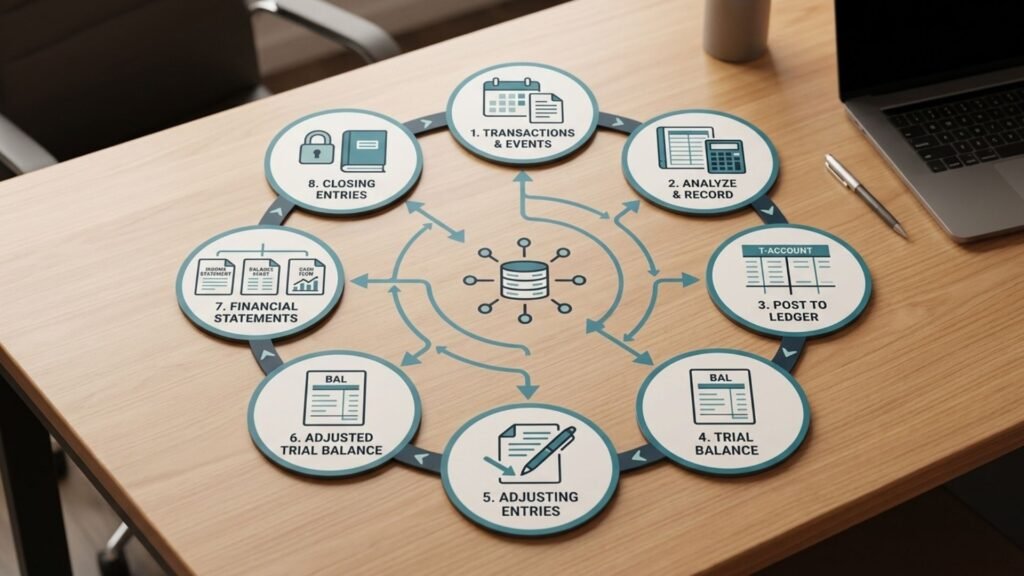
Identifying and Recording Transactions
The cycle begins with identifying every transaction that affects your business’s finances during the period, whether that’s a sale, a purchase, a loan repayment, or a payroll run. Once identified, each transaction gets recorded as a journal entry, following the double-entry principle where every entry affects at least two accounts to keep the books balanced. These entries are logged chronologically, so anyone reviewing them later can trace exactly when and how each transaction occurred.
Accuracy at this stage matters enormously, because any error here tends to ripple forward through every later step in the cycle. Many businesses now use accounting software to capture and categorize transactions automatically from bank feeds, which significantly reduces the manual entry errors that used to be common at this stage.
Posting to the Ledger and Preparing a Trial Balance
Once transactions are recorded as journal entries, they get posted to the general ledger, which organizes all your accounts, cash, revenue, expenses, and everything else, into one central summary. This posting step essentially sorts your chronological journal entries into categorized buckets, so you can see the total activity in each account at a glance.
At the end of the accounting period, a trial balance is prepared, listing every account and its balance to confirm that total debits equal total credits.
If the trial balance doesn’t balance, that’s your signal to go back and find the error before moving forward, rather than letting a mistake quietly carry through to your financial statements. This step is essentially a built-in quality check, and skipping it is one of the most common reasons businesses end up with financial statements that don’t add up correctly.
Adjusting Entries and the Adjusted Trial Balance
Not every financial event lines up neatly with your accounting period, which is exactly why adjusting entries exist. These entries account for things like accrued expenses that haven’t been paid yet, revenue that’s been earned but not yet invoiced, prepaid expenses that need to be spread across multiple periods, and depreciation on equipment or assets. Making these adjustments ensures your financial statements reflect the true economic activity of the period, rather than just the cash that happened to move in or out.
Once adjusting entries are posted, an adjusted trial balance is prepared to confirm everything still balances after these changes have been made. This step is where the accrual principle of accounting really comes into play, giving you a far more accurate picture of performance than simply looking at your bank balance would.
Financial Statements and Closing the Books
With the adjusted trial balance confirmed, it’s finally time to generate your formal financial statement are the income statement, balance sheet, and cash flow statement. These documents translate all the work done in the earlier steps into a format that owners, investors, lenders, and tax authorities can actually read and act on.
The final step is closing the books, where temporary accounts like revenue and expenses are reset to zero and their balances rolled into retained earnings, preparing the system for the next accounting period. This closing process is what allows the cycle to restart cleanly, rather than carrying forward confusing leftover balances from the previous period.
Once the books are closed, the entire cycle begins again for the next reporting period, and this repeating rhythm is exactly what keeps a business’s financial picture current and dependable over time.
Conclusion
The accounting cycle might sound like a rigid, technical process, but really, it’s just a disciplined way of turning everyday business activity into numbers you can actually trust and act on. From identifying transactions all the way through to closing the books, each step exists to catch errors early and build a financial picture that holds up under scrutiny, whether that scrutiny comes from a tax authority, an investor, or simply your own decision-making.
Running this cycle consistently, whether monthly, quarterly, or annually, is what separates businesses with a clear handle on their finances from those constantly scrambling to figure out where they stand.
If keeping up with the full accounting cycle feels like more than you want to manage alongside actually running your business, our team at IndoLedger is here to handle it for you, so your books stay accurate, current, and ready whenever you need them.